 Recently I've been also reading the book 'Hostage to the Devil'. I haven't finished it yet, but I must say it's quite interesting! I will post (copy/paste) here some passages that I think might be interesting (or even important) info. I also might make a little clear summary myself of some quotes. I also have added some pics along the way to make reading more comfortable (I hope it does)
[emphasis mine]:
And without the grace that is born of true faith, Satan does what he does best-he ceases to exist in the eyes of those who do not see. [p.4]
Given the general conditions that surround us in our present society, it becomes all the more important to realize that even in the worst conditions, no person can be Possessed without some degree of cooperation on his or her part.
[...]
The effective cause of Possession is the voluntary collaboration of an individual, through his faculties of mind and will, with one or more of those bodiless, genderless creatures called demons.
[...]
Demonic Possession is not a static condition, an unchanging state. Nor does one become Possessed suddenly, the way one might break an arm or catch the measles. Rather, Possession is an ongoing process. A process that affects the two faculties of the soul: the mind, by which an individual receives and internalizes knowledge. And the will, by which an individual chooses to act upon that knowledge. [p.6-7]
Ample experience with the Possessed has clearly demonstrated that there are certain identifiable factors that dispose an individual to collaborate, in mind and will, with a Possessing demon. Disposing factors, therefore.
The presence of such disposing factors in a person's life does not in itself portend that the person will surely one day be numbered among the Possessed. At the same time, and with only rare exceptions in my experience, one or several of these disposing factors are operational in genuine cases of Possession. Some of the most common disposing factors have been with us for a long time, while others are of more recent vintage.
Some are in the nature of "instruments" outside the individual -the Ouija Board, for example, and the Spiritual Seance. Others are in the nature of "attitudes," whether taugh or self-learned, that are interiorized by the person - Transcendental Meditation and the Enneagram Method are two of the most prominent in this category. In the context of Possession, all disposing factors produce within a person a condition of those two faculties of soul - mind and will - that is most aptly described as an aspiring vacuum. Vacuum, because there is created an absence of clearly defined and humanly acceptable concepts for the mind. Aspiring, because there is a corresponding absence of clearly defined and humanly acceptable goals for the will.
In the case of the Ouija Board, or that of the Seance or TM or the Enneagram Method, the participants must dispose themselves precisely with a view to being opened up; to becoming desirous and accepting of whatever happens along.
The very term, Ouija, for example, is a display of this opening up for the term is composed of the French and German words - Oui and Ja - for Yes. The attitude of the participant in Ouija is literally "Yes, yes." The mind is to be made receptive to whatever suggestions or concepts are presented. If participants also dispose their wills to accept those concepts and act on them, then the predisposing circuit is complete.
The aspiring vacuum is operative and is powerful enough to flood the mind with appropriate concepts that can make a lid for the will's assent.
Often enough, the mind and the will are opened up in precisely this fashion in view of Possession.
Among the vast array of disposing factors likely to lead to Possession, the Enneagram Method is nowadays far and away the most common and pernicious. Given the general state of religion, it is not surprising that the Method's popularity is enormously enhanced by its having been enthusiastically adopted and propagated by Catholic theologians and teachers from the major religious Orders-Jesuit, Dominican, and Franciscan -and by some of the official organs used by the bishops of the United States and Canada charged with teaching religious doctrine to young and adult Catholics. [p. 6-7]
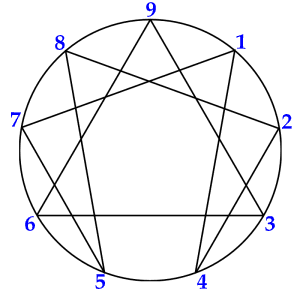
True to its name - enneagram means "nine points," or "marks"- the Enneagram is a nine-pointed mandala-type figure within a circle. The mandala character of the Enneagram is meant to represent the lotus and, as described by Swiss psychologist Carl Jung, is "a symbol depicting the endeavor to reunite the self."
The Enneagram came to the West from a now dead Asianic spiritual master, George Ivanovich Gurdjieff. Gurdjieff claimed in turn that it originated with the Sufi Masters of Islam. It reached the United States via "spiritual teachers" in Chile, Bolivia, and Peru and in the early 1970s was first broadcast here from the Esalen Institute in Big Sur, California, and Loyola University in Chicago. There is now abundant literature on the subject.
According to Enneagram teaching, there are exactly nine types of human personality, each of which is represented by one of the nine points of the Enneagram figure. Each human being is inalterably confined to one, and only one, of those personality types. But within his or her type, each person is infinitely self-perfectible.
Two characteristics of the Enneagram Method comprise moral teachings that are irreconcilable with the basic moral teachings of Catholics in particular and Christians in general.
The basic presumption presented to the mind by the Enneagram Method is that each individual is self-perfectible, morally speaking, within that individual's personality type.
This presumption is in reality a late revival of an ancient heresy known as Pelagianism. It is at odds with the basic Christian teaching that we absolutely depend on the action of divine grace for all moral perfection. Of ourselves, we are helpless. Not only are we not infinitely self-perfectible; we will never of ourselves even escape the grip of our sinful nature. Only supernatural grace enables us to do that. And that grace is simply gratuitous on God's part.
The teaching of the Enneagram Method cuts both God and his grace out of the loop. In fact, there is no longer any loop at all. The individual is cut off from effective knowledge of his or her dependence on God and his supernatural grace for ultimate perfection. He or she is confined to an inalterable personality type, which has been laid out by Enneagram Masters.
The second faulty moral characteristic of the Enneagram Method completes the damage caused by the first. Having fatalistically accepted one's own category, the participant is dependent for perfection on the Enneagramatic exercises suitable for one's personality type. In other words, the soul of the Enneagram disciple is opened out and made docile, with the goal of receiving the promised self-knowledge congruent with his or her type. The soul becomes an apt and classic receptor-an aspiring vacuum -ready for the approach of an intending Possessor.
I have a comment to make here. I haven't yet read Gurdjieff's teachings about the Enneagram, anyhow I think that 'self-perfectible' is a word that can be interpreted in many ways. The way explained by the author here is just one way. And this way, or idea of being self-perfectible, might be a way that might get one open for a Possessor 'to get in'. Just like using an Ouija Board. And that's why knowledge and info is important before one even tries to use these kind of 'instruments'. And being 'helpless' or not depends on how someone thinks, knows, understands and interprets, I think. Carrying on:
In such a setting, the intending Possessor may come as what St. Paul described with dramatic precision as an Angel of Light. But the danger is all the more insidious for that. For in such a situation, the condition commonly called "perfect Possession" may be the result.
As the term implies, a victim of perfect Possession is absolutely controlled by evil and gives no outward indication, no hint whatsoever, of the demonic residing within. He or she will not cringe, as others who are Possessed will, at the sight of such religious symbols as a crucifix or a Rosary. The perfectly Possessed will not bridle at the touch of Holy Water, nor hesitate to discuss religious topics with equanimity.
If convicted of crimes against the law, such a victim will frequently acknowledge "guilt," and even the moral "badness" of the acts committed. More often than not, such a person will petition that his physical life be forfeited; that he be executed for his crimes. Thus, in his own way, he voices the insistent Satanist preference for death over life, and the fixated desire to join the Prince in his kingdom.
Because there is no will left to call the victim's own -and because some part of the victim's will is necessary for any hope of successful Exorcism - remedy is unlikely to succeed even in the event the Possession should somehow be uncovered and verified as the problem. [p.8-9]
In a very real sense, all of us - the Possessed, the professionals who must so frequently deal with them; the parents who fear for their children; everyone who lives in a society degraded by happenings that were only recently unimaginable to us -all are in the same boat.
[...]
Of the five Exorcees whose cases are recounted in Hostage to the Devil, none was perfectly Possessed. Hence, they were all apt subjects for the Rite of Exorcism. Their fortunes and lives have varied considerably since their individual Exorcisms. None fell back into Possession.
- Marianne K. took training as a dental technician, married, and lived for nearly seventeen years. She died of cancer in the early 1980s.
- Jonathan Yves is retired from the active priesthood. He entered the field of computers for a time, but has since abandoned that work and now lives with relatives. He never married.
- Richard O. led a very active life as a counselor and therapist for a number of years in the United States before he migrated to Europe, where he died at the end of the last decade.
- Jamsie Z. pursued his career in radio and is now semi-retired as the president of a company he founded.
- Carl V. tested his religious vocation in more than one monastery before he decided to live almost as a hermit in a remote part of the United States.
More than the other four Excorcees described in Hostage to the Devil, Carl attained what more than one of his acquaintances readily call holiness. In the last two or three years of his life, he was graced with a special insight into the spiritual anguish of men and women who sought him out for counsel. Many of them speak of the radiance in his look and the power he had to bring peace to troubled minds.
Of the Exorcists who presented themselves as hostages to Satan for the liberation of his victims,All five of these Exorcists trained several other men and included in their instruction the wisdom and the selflessness needed for anyone who would voluntarily give himself as hostage in order to liberate another from the bondage of Possession.
- Father Peter,
- Father David M.,
- and Father Gerald are dead.
- Father Mark A. is living in a home for retired priests.
- Father Hartney F. may be the only one to reach the age of one hundred. Still living and retired to a nursing home, Father Hartney is afflicted with severe arthritis and is able to say Mass only with intense difficulty. [p.9-10]
The epitaph on the tombstone of the gentle Father Gerald is testimony to the vocation of all these men, and it is witness to the source of their strength. For that epitaph is from the mouth of the loving Lord in whose glory Gerald now rests: "Greater love than this no man hath, than that a man lay down his life for his friend."
Malachi Martin New York April 1992
How are you fallen from Heaven, Lucifer!
Son of the Dawn! Cut down to the ground!
And once you dominated the peoples!
Didn't you say to yourself: •
I will be as high as Heaven!
I will be more exalted than the stars of God!
I will, indeed, be the supreme leader!
In the privileged places!
I will be higher than the Skies!
I will be the same as the Most High God!
But you shall be brought down to Hell, to the bottom of its pit. And all who see you, will despise you. . . . -Isaiah 14:12-19
. . . "Lord! In your name, even evil spirits are under our control!"
And He said to them: "I saw Satan falling like lightning from Heaven.
You know: I gave you power . . . over all the strength of Satan. . . .
Nevertheless, don't take pride in the fact that spirits are subject to your control, but, rather, because you belong to God . . .
The Father has given Me all power. . . ." -Luke 10:17-22 [p.10]
Michael Strong - Part 1
Possession is not a process of magic. Spirit is real; in fact, spirit is the basis of all reality. "Reality" would not only be boring without spirit; it would have no meaning whatsoever. No horror film can begin to capture the horror of such a vision: a world without spirit.
Evil Spirit is personal, and it is intelligent. It is preternatural, in the sense that it is not of this material world, but it is in this material world. And Evil Spirit as well as good advances along the lines of our daily lives. In very normal ways spirit uses and influences our daily thoughts, actions, and customs and, indeed, all the strands that make up the fabric of life in whatever time or place. Contemporary life is no exception.
To compare spirit with the elements of our lives and material world, which it can and sometimes does manipulate for its own ends, is a fatal mistake, but one that is very often made. Eerie sounds can be produced by spirit-but spirit is not the eerie sound. Objects can be made to fly across a room, but telekinesis is no more spirit than the material object that was made to move. One man whose story is told in this book made the mistake of thinking otherwise, and he nearly paid with his life when he had to confront the error he had made. [p.13-14]
The exorcist is the centerpiece of every exorcism. On him depends everything. He has nothing personal to gain. But in each exorcism he risks literally everything that he values. Michael Strong's was an extreme example of the fate awaiting the exorcist. But every exorcist must engage in a one-to-one confrontation, personal and bitter, with pure evil. Once engaged, the exorcism cannot be called off. There will and must always be a victor and a vanquished. And no matter what the outcome, the contact is in part fatal for the exorcist. He must; consent to a dreadful and irreparable pillage of his deepest self.' Something dies in him. Some part of his humanness will wither from such close contact with the opposite of all humanness-the essence of evil; and it is rarely if ever revitalized. No return will be made to him for his loss. This is the minimum price an exorcist pays. If he loses in the fight with Evil Spirit, he has an added penalty. He may or may not ever again perform the rite of Exorcism, but he must finally confront and vanquish the evil spirit that repulsed him.I wonder why this would be [place - spirit].
The investigation that may lead to Exorcism usually begins because a man or woman-occasionally a child-is brought to the notice of Church authorities by family or friends. Only rarely does a possessed person come forward spontaneously.
The stories that are told on these occasions are dramatic and painful: strange physical ailments in the possessed;
- marked mental derangement;
- obvious repugnance to all signs, symbols, mention, and sight of religious objects, places, people, ceremonies. Often, the family or friends report, the presence of the person in; question is marked by so-called psychical phenomena:
- objects fly around the room;
- wallpaper peels off the walls;
- furniture cracks;
- crockery breaks;
- there are strange rumblings, hisses, and other noises', with no apparent source.
- Often the temperature in the room where the possessed happens to be will drop dramatically.
- Even more often an acrid and distinctive stench accompanies the person.
When such a case is brought to their attention, the first and central problem that must always be addressed by the Church authorities is: Is the person really possessed?
- Violent physical transformations seem sometimes to make the lives of the possessed a kind of hell on earth.
- Their normal processes of secretion and elimination are saturated with inexplicable wrackings ; and exaggeration.
- Their consciousness seems completely colored by the violent sepia of revulsion.
- Reflexes sometimes become sporadic or abnormal, sometimes disappear for a time.
- Breathing can cease for extended periods. Heartbeats are hard to detect.
- The face is strangely distorted, sometimes also abnormally tight and smooth without the slightest line or furrow.
Henri Gesland, a French priest and exorcist who works today in Paris, stated in 1974 that, out of 3,000 consultations since 1968, "there have been only four cases of what I believe to be demonic possession." T. K. Osterreich, on the other hand, states that "possession has been an extremely common phenomenon, cases of which abound in the history of religion." The truth is that official or scholarly census of possession cases has never been made. [p.15]
Certainly, many who claim to be possessed or whom others so describe are merely the victims of some mental or physical disease. In reading records from times when medical and psychological science did not exist or were quite undeveloped, it is clear that grave mistakes were made. A victim of disseminated sclerosis, for example, was taken to be possessed because of his spastic jerkings and slidings and the shocking agony in spinal column and joints. Until quite recently, the victim of Tourette's syndrome was the perfect target for the accusation of "Possessed": torrents of profanities and obscenities, grunts, barks, curses, yelps, snorts, sniffs, tics, foot stomping, facial contortions all appear suddenly and just as suddenly cease in the subject. Nowadays, Tourette's syndrome responds to drug treatment, and it seems to be a neurological disease involving a chemical abnormality in the brain. Many people suffering from illnesses and diseases well known to us today such as paranoia, Huntington's chorea, dyslexia, Parkinson's disease, or even mere skin diseases (psoriasis, herpes, for instance), were treated as people "possessed" or at least as "touched" by the Devil.
Nowadays, competent Church authorities always insist on thorough examinations of the person brought to them for Exorcism, an examination conducted by qualified medical doctors and psychiatrists.
When a case of possession is reported by a priest to the diocesan authorities, the exorcist of the diocese is brought in. If there is no diocesan exorcist, a man is appointed or brought from outside the diocese.
Sometimes the priest reporting the exorcism will have had some preliminary medical and psychiatric tests run beforehand in order to allay the cautious skepticism he is likely to meet at the chancery when he introduces his problem. When the official exorcist enters the case, he will usually have his own very thorough examinations run by experts he knows and whose judgment he is sure he can trust.
In earlier times, one priest was usually assigned the function of exorcist in each diocese of the Church. In modern times, this practice has fallen into abeyance in some dioceses, mainly because the incidence of reported possession has decreased over the last hundred years. But in most major dioceses, there is still one priest entrusted with this function-even though he may rarely or never use it. In some dioceses, there is a private arrangement between the bishop and one of his priests whom he knows and trusts.
There is no official public appointment of exorcists. In some dioceses, "the bishop knows little about it and wants to know less"-as in one of the cases recorded in this book. But however he comes to his position, the exorcist must have official Church sanction, for he is acting in an official capacity, and any power he has over Evil Spirit can only come from those officials who belong to the substance of Jesus' Church, whether they be in the Roman Catholic, the Eastern Orthodox, or the Protestant Communions. Sometimes a diocesan priest will take on an exorcism himself without asking his bishop, but all such cases known to me have failed.
It is recognized both in the pre-exorcism examinations and during the actual exorcism that there is usually no one physical or psychical aberration or abnormality in the possessed person that we cannot explain by a known or possible physical cause. And, apart from normal medical and psychological tests, there are other possible sources for diagnosis. However rickety and tentative the findings of parapsychology, for example, one can possibly seek in its theories of telepathy and telekinesis an explanation of some of the signs of possession. Suggestion and suggestibility, as modern psychotherapists speak of them, can account for many more.
Still, with the diagnoses and opinions of doctors and psychologists in hand, it is often discovered there are wide margins of fluctuation. Competent psychiatrists will differ violently among themselves; and in psychology and medicine, ignorance of causes is often obscured by technical names and jargon that are nothing more than descriptive terms.
Nevertheless, the combined medical and psychological reports are carefully evaluated and usually weigh heavily in the final judgment to proceed or not with an exorcism. If according to those reports there is a definite disease or illness which adequately accounts for the behavior and symptoms of the subject, Exorcism is usually ruled out, or at least delayed to allow a course of medical or psychiatric treatment.
But finally, reports in hand, all evidence in, Church authorities judge the situation from another, special point of view, formed by their own professional outlook. [p.15-16]
They believe that there is an invisible power, a spirit of evil; that this spirit can for obscure reasons take possession of a human being; that the evil spirit can and must be expelled-exorcised-from the person possessed; and that this exorcism can be done only in the name and by the authority and power of Jesus of Nazareth. The testing from the Church's viewpoint is as rigorous in its search as any medical or psychological examination.
In the records of Christian Exorcism from as far back as the lifetime of Jesus himself, a peculiar revulsion to symbols and truths of religion is always and without exception a mark of the possessed person. In the verification of a case of possession by Church authorities, this "symptom" of revulsion is triangulated with other physical phenomena frequently associated with possession-When this triangulation is made of the varied symptoms that may occur in any given case, and medical and psychiatric diagnoses are inadequate to cover the full situation, the decision will usually be to proceed and try Exorcism. [p.16]
- the inexplicable stench;
- freezing temperature;
- telepathic powers about purely religious and moral matters;
- a peculiarly unlined or completely smooth or stretched skin, or unusual distortion of the face, or other physical and behavioral transformations;
- "possessed gravity" (the possessed person becomes physically immovable, or those around the possessed are weighted down with a suffocating pressure);
- levitation (the possessed rises and floats off the ground, chair, or bed; there is no physically traceable support);
- violent smashing of furniture,
- constant opening and slamming of doors,
- tearing of fabric in the vicinity of the possessed, without a hand laid on them; and so on.
There has never been, to my knowledge, an official listing of exorcists together with their biographies and characteristics, so we cannot satisfy our modern craving for a profile of, say, "the typical exorcist." We can, however, give a fairly clear definition of the type of man who is entrusted with the exorcism of a possessed person.All have been sensitive men of solid rather than dazzling minds. Though, of course, there are many exceptions, the usual reasons for a priest's being chosen are his qualities of moral judgment, personal behavior, and religious beliefs-qualities that are not sophisticated or laboriously acquired, but that somehow seem always to have been an easy and natural part of such a man. Speaking religiously, these are qualities associated with special grace.
- Usually he is engaged in the active ministry of parishes.
- Rarely is he a scholarly type engaged in teaching or research.
- Rarely is he a recently ordained priest.
- If there is any median age for exorcists, it is probably between the ages of fifty and sixty-five.
- Sound and robust physical health is not a characteristic of exorcists, nor is proven intellectual brilliance, postgraduate degrees, even in psychology or philosophy, or a very sophisticated personal culture.
- In this writer's experience, the 15 exorcists he has known have been singularly lacking in anything like a vivid imagination or a rich humanistic training.
There is no official training for an exorcist. Before a priest undertakes Exorcism, it has been found advisable-but not always possible or practical-for him to assist at exorcisms conducted by an older and already experienced priest.
Once possession has been verified to the satisfaction of the exorcist, he makes the rest of the decisions and takes care of all the necessary preparations. In some dioceses, it is he who chooses the assistant priest. The choice of the lay assistants and of the time and place of the exorcism is left to him.
The place of the exorcism is usually the home of the possessed person, for generally it is only relatives or closest friends who will give care and love in the dreadful circumstances associated with possession. The actual room chosen is most often one that has had some special significance for the possessed person, not infrequently his or her own bedroom or den. In this connection, one aspect of possession and of spirit makes itself apparent: the close connection between spirit and physical location. The puzzle of spirit and place makes itself felt in many ways and runs throughout virtually every exorcism. There is a theological explanation for it. But that there is some connection between spirit and place must be dealt with as a fact.
Once chosen, the ,room where the exorcism will be done is cleared as far as possible of anything that can be moved. During the exorcism, one form of violence may and most often does cause any object, light or heavy, to move about, rock back and forth, skitter or fly across the room, make much noise, strike the priest or the possessed or the assistants. It is not rare for people to emerge from an exorcism with serious physical wounds. Carpets, rugs, pictures, curtains, tables, chairs, boxes, trunks, bedclothes, bureaus, chandeliers, all are removed.
Doors very often will bang open and shut uncontrollably; but because exorcisms can go on for days, doors cannot be nailed or locked with unusual security. On the other hand, the doorway must be covered; otherwise, as experience shows, the physical force let loose within the exorcism room will affect the immediate vicinity outside the door.
Windows are closed securely; sometimes they may be boarded over in order to keep flying objects from crashing through them and to prevent more extreme accidents (possessed people sometimes attempt defenestration; physical forces sometimes propel the assistants or the exorcist toward the windows).
A bed or couch is usually left in the room (or placed there if necessary), and that is where the possessed person is placed. A small table is needed. On it are placed a crucifix, with one candle on either side of it, holy water, and a prayer book.
Sometimes there will also be a relic of a saint or a picture that is considered to be especially holy or significant for the possessed. In recent years in the United States, and increasingly abroad as well, a tape recorder is used. It is placed on the floor or in a drawer or sometimes, if it is not too cumbersome, around the neck of an assistant.
The junior priest colleague of the exorcist is usually appointed by diocesan authorities. He is there for his own training as an exorcist. He will monitor the words and actions of the exorcist, warn him if he is making a mistake, help him if he weakens physically, and replace him if he dies, collapses, flees, is physically or emotionally battered beyond endurance-and all have happened during exorcisms. The other assistants are laymen. Very often a medical doctor will be among them because of the danger to all present of strain, shock, or injury. The number of lay assistants will depend on the exorcist's expectation of violence. Four is the usual number. Of course, in remote country areas or in very isolated Christian missions, and sometimes in big urban centers, there is no question of assistants. There simply is none available, or there is no time to acquire any. The exorcist must go it alone. [p.18]
An exorcist comes to know from experience what he can expect by way of violent behavior; and, for their own sakes, possessed people must usually be physically restrained during parts of the exorcism. The assistants therefore must be physically strong. In addition, there may be a straitjacket on hand, though leather straps or rope are more commonly used.
It is up to the exorcist to make sure that his assistants are not consciously guilty of personal sins at the time of the exorcism, because they, too, can expect to be attacked by the evil spirit, even though not so directly or constantly as the exorcist himself. Any sin will be used as a weapon.
The exorcist must be as certain as possible beforehand that his assistants will not be weakened or overcome by obscene behavior or by language foul beyond their imagining; they cannot blanch at blood, excrement, urine; they must be able to take awful personal insults and be prepared to have their darkest secrets screeched in public in front of their companions. These are routine happenings during exorcisms. Assistants are given three cardinal rules: they are to obey the exorcist's commands immediately and without question, no matter how absurd or unsympathetic those commands may appear to them to be; they are not to take any initiative except on command; and they are never to speak to the possessed person, even by way of exclamation.
Even with all the care in the world, there is no way an exorcist can completely prepare his assistants for what lies in store for them. Even though they are not subject to the direct and unremitting attack the priest will undergo, it is not uncommon for assistants to quit-or be carried out-in the middle of an exorcism. A practiced exorcist will even go so far as to make a few trial runs of an exorcism beforehand, on the old theory that forewarned is forearmed-at least to some degree.
Timing in an exorcism is generally dictated by circumstances. There is usually a feeling of urgency to begin as soon as possible. Everyone involved should have an open schedule. Rarely is an exorcism shorter than some hours-more often than not ten or twelve hours. Sometimes it stretches for two or three days. On occasion it lasts even for weeks. Once begun, except on the rarest occasions, there are no time outs, although one or other of the people present may leave the room for a few moments, to take some food, to rest very briefly, or go to the bathroom. (One strange exorcism where there was a time out is described in this book. The priest involved would have preferred one hundred times going straight through the exorcism rather than suffer the mad violence that caused the delay.)
The only people in an exorcism who dress in a special way are the exorcist and his priest assistant. Each wears a long black cassock that covers him from neck to feet. Over it there is a waist-length white surplice. A narrow purple stole is worn around the neck and hangs loosely the length of the torso.
Normally, the priest assistant and the lay assistants prepare the exorcism room according to the exorcist's instructions. They and the exorcee are ready in the room when the exorcist enters, last and alone.
There is no lexicon of Exorcism; and there is no guidebook or set of rules, no Baedeker of Evil Spirit to follow. The Church provides an official text for Exorcism, but this is merely a framework. It can be read out loud in 20 minutes. It merely provides a precise formula of words together with certain prayers and ritual actions, so that the exorcist has a preset structure in which to address the evil spirit. In fact, the conduct of an exorcism is left very much up to the exorcist. [p.18-19]
So far, quite interesting huh?! Well this part that comes up is even more interesting, check it out [I will post this in a different color, because I think it might be important for research later or for looking up etc] [p.19-23]:
Nevertheless, any practiced exorcist I have spoken with agrees that there is a general progress through recognizable stages in an exorcism, however long it may last. One of the most experienced exorcists I have known and who was in fact the mentor of the exorcist in the first case related in this book, gave names to the various general stages of an exorcism. These names reflect the general meaning or effect or intent of what is happening, but not the specific means used by the evil spirit or by the exorcist. Conor, as I call him, spoke of Presence, Pretense, Breakpoint, Voice, Clash, and Expulsion. The events and stages these names signify occur in nine out of every ten exorcisms.Here he writes a little more about the upcoming 5 cases he's gonna write about:
Presence:
From the moment the exorcist enters the room, a peculiar feeling seems to hang in the very air. From that moment in any genuine exorcism and onward through its duration, everyone in the room is aware of some alien Presence. This indubitable sign of possession is as unexplainable and unmistakable as it is inescapable. All the signs of possession, however blatant or grotesque, however subtle or debatable, seem both to pale before and to be marshaled in the face of this Presence.
There is no sure physical trace of the Presence, but everyone feels it. You have to experience it to know it; you cannot locate it spatially- beside or above or within the possessed, or over in the corner or under the bed or hovering in midair.
In one sense, the Presence is nowhere, and this magnifies the terror, because there is a presence, an other present. Not a "he" or a "she" or an "it." Sometimes, you think that what is present is singular, sometimes plural. When it speaks, as the exorcism goes on, it will sometimes refer to itself as "I" and sometimes as "we," will use "my" and "our."
Pretense:
Invisible and intangible, the Presence claws at the humanness of those gathered in the room. You can exercise logic and expel any mental image of it. You can say to yourself: "I am only imagining this. Careful! Don't panic!" And there may be a momentary relief. But then, after a time lag of bare seconds, the Presence returns as an inaudible hiss in the brain, as a wordless threat to the self you are. Its name and essence seem to be compounded of threat, to be only and intensely baleful, concentratedly intent on hate for hate's sake and on destruction for destruction's sake. In the early stages of an exorcism, the evil spirit will make every attempt to "hide behind" the possessed, so to speak-to appear to be one and the same person and personality with its victim. This is the Pretense.
The first task of the priest is to break that Pretense, to force the spirit to reveal itself openly as separate from the possessed-and to name itself, for all possessing spirits are called by a name that generally (though not always) has to do with the way that spirit works on its victim.
As the exorcist sets about his task, the evil spirit may remain silent altogether; or it may speak with the voice of the possessed, and use past experiences and recollections of the possessed. This is often done skillfully, using details no one but the possessed could know. It can be very disarming, even pitiful. It can make everyone, including the priest, feel that it is the priest who is the villain, subjecting an innocent person to terrible rigors. Even the mannerisms and characteristics of the possessed are used by the spirit as its own camouflage.
Sometimes the exorcist cannot shatter the Pretense for days. But until he does, he cannot bring matters to a head. If he fails to shatter it at all, he has lost. Perhaps another exorcist replacing him will succeed. But he himself has been beaten.
Every exorcist learns during Pretense that he is dealing with some force or power that is at times intensely cunning, sometimes supremely intelligent, and at other times capable of crass stupidity (which makes one wonder further about the problem of singular or plural); and it is both highly dangerous and terribly vulnerable.
Oddly, while this spirit or power or force knows some of the most secret and intimate details of the lives of everyone in the room, at the same time it also displays gaps in knowledge of things that may be happening at any given moment of the present. But the priest must not be lulled by small victories or take chances on hoped-for stupidities. He must be ready to have his own sins and blunders and weaknesses put into his mind or shouted in ugliness for all to hear. He must not make excuses for his past, or wither as even his loveliest memories are fingered by ultimate filth and contempt; he must not be sidetracked in any way from his primary intention of freeing the possessed person before him. And he must at all costs avoid trading abuse or getting into any logical arguments with the possessed. The temptation to do so is more frequent than one might think, and must be regarded as a potentially fatal trap that can shatter not only the exorcism, but quite literally shatter the exorcist as well.
Breakpoint:
Accordingly, as the Pretense begins to break down, the behavior of the possessed usually increases in violence and repulsiveness. It is as though an invisible manhole opens, and out of it pours the unmention-ably inhuman and the humanly unacceptable. There is a stream of filth and unrestrained abuse, accompanied often by physical violence, writhing, gnashing of teeth, jumping around, sometimes physical attacks on the exorcist.
A new hallmark of the proceedings enters as the Breakpoint nears, and ushers in one of the more subtle sufferings the exorcist must undergo: confusion. Complete and dreadful confusion. Rare is the exorcist who does not falter here for at least a moment, enmeshed in the peculiar pain of apparent contradiction of all sense.
His ears seem to smell foul words. His eyes seem to hear offensive sounds and obscene screams. His nose seems to taste a high-decibel cacophony. Each sense seems to be recording what another sense should be recording. Each nerve and sinew of onlookers and participants becomes rigid as they strive for control. Panic-the fear of being dissolved into insanity-runs in quick jabs through everyone there. All present experience this increasingly violent and confusing assault. But the exorcist is the one who rides the storm. He is the direct target of it all.
The Breakpoint is reached at that moment when the Pretense has finally collapsed altogether. The voice of the possessed is no longer used by the spirit, though the new, strange voice may or may not issue from the mouth of the victim. In Thomas Wu's case, the alien voice did come from the possessed's mouth; and that was why the police captain was so startled. The sound produced is often not even remotely like any human sound.
At the Breakpoint, for the first time, the spirit speaks of the possessed in the third person, as a separate being. For the first time, the possessing spirit acts personally and speaks of "I" or "we," usually interchangeably, and of "my" and "our" or "mine" and "ours."
Voice:
Another very frequent sign that the Breakpoint has been reached is the appearance of what Father Conor called the Voice.
The Voice is an inordinately disturbing and humanly distressing babel. The first few syllables seem to be those of some word pronounced slowly and thickly-somewhat like a tape recording played at a subnormal speed. You are just straining to pick up the word and a layer of cold fear has already gripped you-you know this sound is alien. But your concentration is shattered and frustrated by an immediate gamut of echoes, of tiny, prickly voices echoing each syllable, screaming it, whispering it, laughing it, sneering it, groaning it, following it. They all hit your ear, while the alien voice is going on unhurriedly to the next syllable, which you then try to catch, while guessing at the first one you lost. By then, the tiny, jabbing voices have caught up with that second syllable; and the voice has proceeded to the third syllable; and so on.
If the exorcism is to proceed, the Voice must be silenced. It takes an enormous effort of will on the part of the exorcist, in direct confrontation with the alien will of evil, to silence the Voice. The priest must get himself under control and challenge the spirit first to silence and then to identify itself intelligibly.
As in all things to do with Exorcism of Evil Spirit, the priest makes this challenge with his own will, but always in the name and by the authority of Jesus and his Church. To do so in his own name or by some fancied authority of his own would be to invite personal disaster. Merely human power unadorned and without aid cannot cope with the preternatural. (It is to be remembered that when we speak of the preternatural, we are not speaking about what are known as poltergeists.)
Clash:
Usually, at this point and as the Voice dies out, a tremendous pressure of an obscure kind affects the exorcist. This is the first and outermost edge of a direct and personal collision with the "will of the Kingdom," the Clash.
We all know from our personal experience that there can be no struggle of single personal wills without that felt and intuitive contact between two persons. There is a two-way communication that is as real as a conversation using words. The Clash is the heart of a special and dreadful communication, the nucleus of this singular battle of wills between exorcist and Evil Spirit.
Painful as it will be for him, the priest must look for the Clash. He must provoke it. If he cannot lock wills with the evil thing and force that thing to lock its will in opposition to his own, then again the exorcist is defeated.
The issue between the two, the exorcist and the possessing spirit, is simple. Will the totally antihuman invade and take over? Will it, noisome and merciless, seep over that narrow rim where the exorcist would hold his ground alone, and engulf him? Or will it, unwillingly, protestingly, under a duress greater than its single-track will, stop, identify itself, cede, retire, disappear, and be volatilized back into an unknown pit of being where no man wants to go ever?
Expulsion:
Even with all the pressure on him, and in fullest human agony, if the exorcist has got this far, he must press home. He has gained an advantage. He has already forced the evil spirit to come out on its own. If he has not been able to until now, he must finally force it to give its name. And then, some exorcists feel, the exorcist must pursue for as much information as he can. For in some peculiar way, as exorcists find, the more an evil spirit can be forced to reveal in the Clash and its aftermath, the surer and easier will be the Expulsion when that moment comes. To force as complete an identification as possible is perhaps a mark of domination of one will over another.
It is of crucial interest to speculate about the violence provoked by Exorcism-the physical and mental struggles that are so extreme they can bring on death. Why would spirit battle so? Why not leave and waft off invisibly to someone or someplace else?
For spirit itself seems to suffer in these battles.
Time and again, in exorcism after exorcism, there occurs that curious thing to do with spirit and place, the strange puzzle mentioned previously in connection with the room chosen for the exorcism. When Jesus expelled the unclean spirits, those spirits showed concern for where they might go. In record after record, as well as in several exorcisms recounted in this book, the possessing spirits wail in lament and questioning pain: "Where shall we go?" "We too have to possess our habitation." "Even the Anointed One gave us a place with the swine." "Here . . . we can't stay here any longer."
Evil Spirit, having found a home with a consenting host, does not appear to give up its place easily. It claws and fights and deceives and even risks killing its host before it will be expelled. How violent the struggle probably depends on many things; the intelligence of the spirit being dealt with and the degree of possession achieved over the victim are perhaps two one could speculate about.
Whatever determines the actual pitch of violence, once the exorcist has forced the invading spirit to identify itself, and sustained the first wordless bout of the Clash, and then invoked its formal condemnation and expulsion by the Exorcism rite, the immediate result is generally a struggle tortuous beyond/imagining, an open violence that leaves all subtlety behind.
The person possessed is by now obviously aware in one way or another of what possessed him. Frequently he becomes a true battleground for much of the remainder of the exorcism, enduring unbelievable punishment and strain.
It is sometimes possible for the exorcist to appeal directly to the possessed person, urging him to use some part of his own will still free of the spirit's influence and control, and engage directly in the fight, aiding the exorcist. And at such moments no animal pinned helplessly to the ground struggles more pathetically against the drinking of its life's blood by a voracious and superior cruelty. The very nauseous character of the possessed person's appearance and behavior appears to be a sign of his desire for deliverance, a desperate sign of struggle, evidence of a revolt where once he had consented.
Increasingly what had possessed him is being forced into the open, all the while protesting its victim's revolt and its own expulsion. The violence of the contortions and the physical disfigurement of the possessed can reach a degree one would think he could not possibly withstand.
The exorcist, too, comes in for full attack now. Once cornered, the evil spirit seems able to call on a superior intelligence, and will try to lure the exorcist on to a field boobytrapped and mined with situations from which no human can extricate himself.
Any weakness in the religious faith that alone sustains the exorcist or any fatigue will allow the exorcist's mind to be flooded with a terrible light he cannot fend off-a light that can burn the very roots of his reason and turn him emotionally into the most servile of slaves desperate to be liberated from all bodily life.
These are only some of the dangers and traps that face every exorcist. His pain is physical, emotional, mental. He has to deal with what is eerie but not enthralling; with something askew, but intelligently so; with a quality that is upside down and inside out, but significantly so. The mordant traits of nightmare are there in full regalia, but this is no dream and permits him no thankful remission.
He is attacked by a stench so powerful that many exorcists start vomiting uncontrollably. He is made to bear physical pain, and he feels anguish over his very soul. He is made to know he is touching the completely unclean, the totally unhuman. All sense may suddenly seem nonsense. Hopelessness is confirmed as the only hope. Death and cruelty and contempt are normal. Anything comely or beautiful is an illusion. Nothing, it seems, was ever right in the world of man. He is in an atmosphere more bizarre than Bedlam.
If, in spite of his emotions and his imagination and his body-all trapped at once in pain and anguish-if, in spite of all this, the will of the exorcist holds in the Clash, what he does is to approach his final function in this situation as an authorized human witness for Jesus. By no power of his, on account of no privilege of his own, he calls finally on the evil spirit to desist, to be dispossessed, to depart and to leave the possessed person.
And, if the exorcism is successful, this is what happens. The possession ends. All present become aware of a change around them. The sense of Presence is totally, suddenly absent. Sometimes there are receding voices or other noises, sometimes only dead silence.Not so for the exorcists, during and after their grisly work. They carry nagging doubts and bitter conflicts untellable to family, friend, superior, or therapist. Their personal traumas lie beyond the reach of soothing words and deeper than the sweep of any consoling thoughts.
- Sometimes the recently possessed may be at the end of his strength;
- sometimes he will wake up as from a dream, a nightmare, or a coma.
- Sometimes the former victim will remember much of what he has been through;
- sometimes he will remember nothing at all.
They share their punishment with none but God. Even that has its peculiar sting of difficulty. For it is a sharing by faith and not by face-to-face communication. But only thus do these men, seemingly ordinary and commonplace in their lives, persevere through the days of quiet horror and the nights of sleepless watching they spend for years after as their price of success, and as abiding reminders that, once upon a time, another human being was made whole, because they willingly incurred the direct displeasure of living hatred.
The following five case histories are true. The lives of the people involved are told on the basis of extensive interviews with all of the principals involved, with many of their friends and relatives, and with many others involved directly or indirectly in minor ways. All interviews have been independently checked for factual accuracy wherever possible. The exorcisms themselves are reproduced from the actual tapes made at the time and from the transcripts of those tapes. The exorcisms have necessarily been cut for reasons of length; all of the exorcisms recorded here lasted more than 12 hours.
I have chosen these five cases from among a greater number known and available to me because, both singly and taken together, they are dramatic illustrations of the way in which personal and intelligent evil moves cunningly along the lines of contemporary fads and interests, and within the usual bounds of experience of ordinary men and women. No fourteenth- or fifteenth- or sixteenth-century case, for all its possible romantic appeal, would have any relevancy for us today. On the contrary, it would remain a simple matter for us to dismiss such cases as fables made up to suit the fears or fancies of "more ignorant" people of "less sophisticated" times. Each case presented here includes as an important element some basic attitude or attitudes popular in our own society. In the possessed person, it is pushed to a narrow and frightening extreme.
In the first case, Zio's Friend and the Smiler, the insistence is that there is no essential difference between good and evil, and ultimately no difference between being and nonbeing; that all values are subject only to one's personal preferences.
In Father Bones and Mister Natch, the compelling idea that was seized by Evil Spirit seemed to be that all mysteries can and are resolved in "natural" (i.e., rational or scientific or quantifiable) explanations; that there can be no relevance for the modern person in anything that cannot be rationally understood; and that there can be no truth important to man beyond what is rational.
In The Virgin and the Girl-Fixer, the battle concerned some of the great, deep, and mysterious "givens" of our very nature and our society-in this case, gender and human love. The priest in this case said to me a few months before he died, in one of the most profound conversations of my life: "A bird doesn't fly because it has wings. It has wings because it flies." We will ignore that mysterious truth in its applications to our sexuality and our gender only at our great peril, I believe.
In Uncle Ponto and the Mushroom-Souper, we have an example of what may be happening to many in our modern society-without their realizing it and without those around them taking cognizance of it. For it seems that there is an individualism, a purely personalistic interpretation of human life abroad today, which exceeds by far the bounds of what used to be known as selfishness and egotism. It has produced in thousands of people an aberrant and idiosyncratic behavior which is truly destructive.
In The Rooster and the Tortoise, the fatal confusion (and in this case it was literally almost fatal) was between spirit and psyche; between those parts and attributes of ours that are quantifiable, and yet through which spirit most easily makes itself known. If everything we have taken to be of spirit can be made to seem a product merely of the human psyche, with no meaning or significance beyond its factualness, then love can be made to seem only a chemical interraction, and love's paradigm is killed. [p.23-24]
In each case, one basic note of possession is confusion.Confusion, it would seem, is a prime weapon of evil.
- Sex is confused with gender.
- Spirit is confused With psyche.
- Moral value is confused with absence of any value.
- Mystery is confused with untruth.
- And, in every case, rational argument is used, not to clarify, but as a trap, to foster confusion and to nurture it as a major weapon against the exorcist.
There is much more to be observed and said about the meaning of possession. Not everything can be covered in a single volume. But possession and Exorcism are not themselves mere fads with no interest beyond the bizarre and significantly frightening. They are tangible expressions of the reality which envelops the daily lives of ordinary people. No study of possession and Exorcism cases within the Christian optic would be adequate without a minimum of explanation -from the Christian point of view-about that reality: what takes place in possession, and how that degrading process develops in a particular individual. Such an explanation occupies the final section of this book.
This study makes no attempt to answer the ultimate puzzle of possession: why this person rather than that person becomes the object of diabolic attack which can end in partial or perfect possession. The answer certainly does not lie in psychological probings, in heredity, or in social phenomena. A final answer will include, as prime ingredients, the personal free choice which each individual makes and the mystery of human predestination. About free choice we know the essentials: I can choose evil for no other reason or motive than that I choose evil. Some apparently do. About predestination we know little or nothing. The puzzle remains.
All of the men and women involved in the five cases reported here are known to me personally; they have given their fullest cooperation on the condition that their identities and those of their families and friends not be revealed. Therefore, all names and places have been changed, and other possible pointers to identity have been obscured. Any similarity between the cases reported here and any others that may have occurred is unintentional and purely coincidental.
You'll have to read the stories yourself in the book if you want to know them! I'm gonna copy some pieces from the 5 stories here that I think might be important or significant etc. I am however gonna post the 1st story, to see if it might be better or not to copy the whole story or just some pieces of it. Just experimenting here.
The Cases
1. Zio's Friend and the Smiler
[In the first case, Zio's Friend and the Smiler, the insistence is that there is no essential difference between good and evil, and ultimately no difference between being and nonbeing; that all values are subject only to one's personal preferences.]Victim: [Marianne K. took training as a dental technician, married, and lived for nearly seventeen years. She died of cancer in the early 1980s.]
Peter took one more breath of fresh air. He was reluctant to pull the open window shut against the uproar on 125th Street 15 stories below. It was the first time in history that a Roman Pope was driving through New York streets, and the very air was alive with excitement. The Pope's motorcade had already passed over Willis Avenue Bridge into the Bronx on its way to Yankee Stadium. The crowds were still milling around. Some nuns scurried about like frenzied penguins blowing whistles and marshaling lines of white-clad schoolgirls. Hot-dog vendors shouted their prices. A dowdiry dressed young woman and her child peddled plastic little popes to passersby. Two policemen were removing wooden barriers. A garbage truck snorted and honked its way through the traffic. Father Peter closed the window finally, drew the curtains together, and turned back toward the bed.
The room was quiet again, except for the irregular breathing of twenty-six-year-old Marianne. She lays on a gray blanket thrown over the bare mattress. With her faded jeans, yellow body-shirt, auburn hair straggling over her forehead, the pallor of her cheeks, and the aging, off-white color of the walls around her, she seemed part of a tragically washed-out pastel. Except for a funny twist to her mouth, her face had no expression.
To Peter's left, with their backs to the door, stood two bulky men. One: an ex-policeman and a friend of the family, a veteran of 32 years on the force, where, he thought, he had seen everything. He was about to find out that he hadn't. Sixtyish, balding, clad in dungarees, his arms folded over his chest, his face was a picture of puzzlement. The other the closest acquaintance of Marianne's father, whom the children called uncle, was a bank manager and a grandfather in his midfiftie red-faced and jowled, in a blue suit, his arms hanging by his sides, fixed on Marianne's face with an expression of helpless fear. Both the men, athletic and muscular, had been asked to assist at the exorcism of Marianne K., to quell any physical violence or harm she might attempt. Marianne's father, a wispy man with reddened eyes and drawn face, stood with the family doctor. He was praying silently. Peter always insisted on having a member of the family present- at exorcism. As if in contrast to the others, the young doctor, a| psychiatrist, wore a concentrated, almost studious look as he checked the girl's pulse.
Peter's colleague, Father James, a priest in his thirties, stood at the foot of the bed. Black-haired, full-faced, youthful, apprehensive, his black, white, and purple robes were a uniform for him. On Peter, with his tousled gray hair and hollow-cheeked look, the same colors melted into a veiled unity. James was dressed up ready to go. Peter, the; campaigner, had been there.
On a night table beside James two candles flickered. A crucifix rested between them. In one corner of the room there was a chest of ; drawers. "Should have had it removed before we started," Peter thought. The chest, originally left there in order to hold a tape recorder, had become quite a nuisance. Probably would continue to be until the whole business was finished, Peter thought. But he knew better than to fiddle with any object in the room, once the exorcism had begun.
It was a Monday, 8:15 P.M., the seventeenth hour into Peter's third exorcism in thirty years. It was also his last exorcism, although he could not know that. Peter felt sure that he had arrived at the Breakpoint in the rite. In the few seconds it took him to cross from the window to her bed, Marianne's face had been contorting into a mass of crisscrossing lines. Her mouth twisted further and further in an S-shape. The neck was taut, showing every vein and artery; and her Adam's apple looked like a knot in a rope.
The ex-policeman and her uncle moved to hold her. But her voice threw them back momentarily like a whiplash:
"You dried-up fuckers! You've messed with each other's wives. And with your own peenies into the bargain. Keep your horny paws off me!
"Hold her down!" Peter spoke peremptorily. Four pairs of hands clamped on her. "Jesus have mercy on my baby," muttered her father. The ex-policeman's eyes bulged. "YOU!" Marianne screamed, as she lay pinned flat on the bed, her eyes open and blazing with anger, "YOU! Peter the Eater. Eat my flesh, said she. Suck my blood, said she. And you did! Peter the Eater! You'll come with us, you freak. You'll lick my arse and like it, Peeeeeeeetrrrrrr," and her voice sank through the "rrrr" to an animal gurgle.
Something started to ache in Peter's brain. He missed a breath, panicked because he could not draw it, stopped and waited, swaying on his feet. Then he exhaled gratefully. To the younger priest he looked frail and vulnerable. Father James handed Peter his prayer book, and they both turned to face Marianne.
Almost a year later, in 1966, on the day Peter was buried in Calvary Cemetery, his younger colleague, Father James, chatted with me after the funeral service. "It doesn't matter what the doctor said" (the official report gave coronary thrombosis as cause of death), "he was gone, really gone, after that last to-do. Just a matter of time. Mind you, it wasn't that he wasn't brave and devoted. He was a real man of God before and after the whole thing. But it took that last exorcism to make him realize that life knocks the stuffing out of any decent man." Peter had apparently never emerged from a gentle reverie after the exorcism of Marianne; and he always spoke as if he were talking for the benefit of someone else present. It was as exasperating as listening to one side of a telephone conversation.
"He was never the same again," said James. "Some part of him passed into the Great Beyond during the final Clash, as you call it." Then, after a pause and musingly, almost to himself: "Can you beat that? He had to be born in Lisdoonvarna" sixty-two years ago, be reared beside Killarney, and come all the way over here three times-just to find out the third time where he was supposed to die; and how, and when. Makes you think what life's all about. You never know how it's going to end. Peter did not become an American citizen, even. All that travel. Just to die as the Lord had decided."
Peter was one of seven children, all boys. His father moved from County Clare to Listowel, County Kerry, where he prospered as a wine merchant. The family lived in a large two-story house overlooking the river Feale. They were financially comfortable and respected. Their Roman Catholicism was that brand of muscular Christianity which the Irish out of all Western nations had originated as their contribution to religion.
Peter spent his youth in the comparative peace of "the old Rritish days" before the Irish Republican Brotherhood (parent of the IRA), the Irish Volunteers, and the 1916 Rebellion started modern Ireland off on the stormy course of fighting for the "terrible beauty" that lured Patrick Pearse, James Connolly, Eamonn De Valera, and the other leaders into the deathtrap of bloodletting, where, 50 years later, in Peter's declining years, blood was still being shed.
School filled three-quarters of the year for Peter. Summers were spent at Real Strand, at Ballybunion seaside, or harvesting on his grandfather's farm at Newtownsands. One such summer, his sixteenth, Peter had his only brush with sex. He had lain for hours among the sand dunes of Beal Strand with Mae, a girl from Listowel whom he had known for about three years. That day, their families had gone to the Listowel races.
Innocent flirting developed into simple love play and finally into a fervid exchange of kisses and caresses, until they both lay naked and awesomely happy beneath the early-evening stars, the warmth undulating and glowing sweetly through their bodies as they huddled close together. Afterward, Mae playfully nicknamed him "Peter the Eater," To calm his fear she added: "Don't worry. No one will know how you made love to me. Only me."
For about a year afterward, he was interested in girls and particularly in Mae. Then early in his eighteenth year, he began to think of the priesthood. By the time he finished schooling, his mind was made up. Peter had told me once: "When we said goodbye, that summer of 1922, Mae teased me: 'If you ever leave the seminary and) don't marry me, I'll tell everyone your nickname.' She never told a; human soul.
But, of course, they knew." Peter's sole but real enemies were the shadowy dwellers of "the Kingdom" whom he vaguely called "they." He gave me a characteristic look and stared away over my head. Mae had died in 1929 of a ruptured appendix.
Peter started his studies at Killarney Seminary and finished them at Numgret with the Jesuits. He was no brilliant scholar, but got very good grades in Canon Law and Hebrew, which he pronounced with an Irish brogue ("My grandfather was from one of the Lost Tribes"), acquired a reputation for good, sound judgment in moral dilemmas, and was renowned locally because with one deft kick of a football he could knock the pipe out of a smoker's mouth at 30 yards and not even graze the man's face.
Ordained priest at twenty-five, he worked for six years in Kerry. Then he did a first stint in a New York parish for three years. He was present twice at exorcisms as an assistant. On a third occasion, when he was present merely as an extra help, he had to take over from the exorcist, an older man, who collapsed and died of a heart attack during the rite.
Two weeks before he sailed home to Ireland for his first holiday in three years, the authorities assigned him his first exorcism. "You're young, Father. I wish you'd had more experience," was the way he recalled the bishop's instructions, "but the Old Fella won't have much on you or over you. So go to it."
It had lasted 13 hours ("In Hoboken, of all places," he used to say whimsically), and had left him dazed and ill at ease. He never forgot the statement of murderous intent hurled at him by the man he had exorcised. Through foaming spittle and clenched teeth and the smell of a body unwashed for two years prior, the man had snarled:
"You destroy the Kingdom in me, you shit-faced alien Irish pig. And you think you're escaping. Don't worry. You'll be back for more. And more. Your kind always come back for more. And we will scorch the soul in you. Scorch it. You'll smell. Just like us! Third strike and you're out! Pig! Remember us!"
Peter remembered. But a two-week vacation in County Clare restored him to his energy and verve. "God! The scones running with salty butter, and the hot tea, and the Limerick bacon, and the soft rain, and the peace of it all! 'Twas great."
Most of Peter's wounds were not inflicted by the harsh realities of the world around him; but, deep within him, they opened as his way of responding to the evil he sometimes sensed in daily life.
Those who still remembered him in 1972 agreed that Peter had been neither genius nor saint. Black-haired, blue-eyed, raw-boned in appearance, he was a man of little imagination, deep loyalties, loud laughter, gargantuan appetite for bacon and potatoes, an iron constitution, an inability to hate or bear a grudge, and in a state of constant difference of opinion with his bishop (a tiny old man familiarly called "Packy" by his priests). Peter was somewhat lazy, harmlessly vain about his 6' 2" height, and a lifelong addict of Edgar Wallace detective stories. "He had this distinct quality," remarked one of his friends. "You felt he had a huge spirit laced with cast-iron common sense and untouched by any pettiness."
In normal circumstances, Peter would have stayed on permanently in Ireland after his vacation of scones and soft rain. He would have worked in parishes for some years, then acquired a parish of his own. But there was something else tugging at his heart and something else written in his stars. When he left for New York at the outbreak of the Korean War in order to replace a chaplain who had been called up, he recalled the exorcism in Hoboken. "Third strike and you're out! Pig! Remember!"
He remarked jokingly to a worried friend who knew the whole story: " 'Tis not the third time yet!"
In January 1952, he was asked to do his second exorcism. His effectiveness in the first exorcism and the resilient way he had taken it recommended him to the authorities.
The exorcism took place in; Jersey City. And, in spite of its length (the better part of three days and three nights), it took very little out of him physically or mentally.
Spiritually, it had some peculiar significance for him.
"It was a sort of warmer-upper for the 1965 outing," he told me in 1966. "The ceremony lasted too long for my liking, was hammer and tongs all the way, almost beat us. But there was no great strain inside here [pointing to his chest]." And he added with a significance that eluded me then: "Jesus had a forerunner in the Baptist. I suppose; darkness has its own."
Looking back on his role as exorcist today, it is clear to me that first two exorcisms prepared him for the third and last one. They were three rounds with the same enemy. The exorcee that January was a sixteen-year-old boy of Hispanic origin who had been treated for epilepsy over a period of years, only to lie finally declared nonepileptic and physically sound as a bell by a team of doctors from Columbia Presbyterian Hospital. Nevertheless, on the boy's return home, all the dreadful disturbances started all over again in a much more emphasized way, so the parents, turned to their priest.
"If he met the Devil at the top of the stairs one morning and saw; Jesus Christ standing at the bottom," added another, "he wouldn't turn his back on the one in his hurry to get down to the other. He'd back down. Just to be sure."
"They tell me you've a ... eh ... a sort of a way with the Devil, Father," said the wheezy, red-faced monsignor, grinning awkwardly as he gave the necessary permissions and instructions to Peter. Then, stirring in his chair, he added grimly as a bad Catholic joke: "But don't bring him back here to the Chancery with you. Get rid of him or it or her or whatever the devil it is. We have enough of all that on our backs here already."
It had gone well. The boy became Peter's devoted friend. Later he went to Vietnam and died in an ambush late one night outside Saigon. His commanding officer wrote, enclosing an envelope with Peter's name on it which the dead man had left behind. It contained a piece of bloodstained linen and a short note. Over a decade previously, just before his release from possession, in a final paroxysm of revolt and appeal, he had clawed at Peter's wrist, and Peter's blood had fallen on his shirt sleeve. "I kept this as a sign of my salvation, Father," the note said. "Pray for me. I will remember you, when I am with Jesus."
Peter was then forty-eight years old and in his prime as a priest. Yet in himself, he suffered from a growing sense of inadequacy and worthlessness. He felt that, in comparison with many of his colleagues who had attained degrees, qualifications, high offices, and acknowledged expertise, he had very little to show by way of achievement. "I have no riches inside me," he wrote to a brother of his, "just black poverty. Sometimes it darkens my soul." When his turn for a parish of his own came around, he was passed over. (Packy was dead already; but, some said, the dead bishop had made sure in his records that Peter would be passed over.)
Peter, in fact, was a maverick. The normal priest found him inferior in social graces but superior in judgment, lacking in ecclesiastical know-how and ambition but very content with his work. Sometimes his protestations of being "poor inside," of having "no excellent talents" sounded hollow when matched with his stubborn and opinionated attitudes. Anyway, the normal bishop would take one look into his direct gaze and decide that his own authority was somehow at stake. For Peter's stare was not insolent, but yet unwavering; it acknowledged the demands of worth but was devoid of any subservience. It said: "I respect you for what you represent. What you are is something else." Such a man was unsettling for the absolutist mind and threatening for the authoritarian bent of most ecclesiastics.
Beyond the occasional funny remark, such as "The higher they go, the blacker their bottoms look," Peter gave no outward impression of discontent or anxiety. A lack of self-confidence saved him from revolt or disgust. And he bore it all lightly. "Well, Father Peter," one bishop joshed him as he left to do a three-month stint in London parish work, "off you go to hell or to glory, eh?" Peter laughed it off: "In either case, bishops get the priority, my lord."
Had he raised protests and used the influential friends at his disposal, he would doubtless have retired in good time to the rural repose of a peaceful Kerry parish and the extraordinary autonomy of a parish priest. (A pope or a bishop approached any settled "P.P." with care. Only his housekeeper could make a frontal assault on a parish priest's autonomy. But, then again, Irish housekeepers were a race unto themselves.)
As Peter was and as he chose to remain-in strict dependence on ecclesiastical whims and never striking out to seek a fixed position-he was available to be tapped for a temporary visit to Rome and an accidental meeting that changed him profoundly.
After his second exorcism, there were ten more years of "helping out" in various dioceses, practically always on a temporary basis as substitute for other priests. And then a chance breakfast in late September 1962 brought him together with a West Coast bishop who, on his way to the opening of the Second Vatican Council in Rome, stayed a few days in New York. The bishop was well known for his sympathy with mavericks and his welcome for "hard cases." Like all the bishops who went to the council, he needed one or two experts in theology to be his advisors in Rome. He needed, in particular, a theologian counselor skilled in pastoral matters.
The next day Peter was aboard a TWA flight with the bishop enroute to the Eternal City. But for that trip, he probably would not have been at the side of Marianne three years later. And he certainly would never have come close to two men who had a sudden, deep influence on the rest of his life. In Rome, Peter performed his duties as a counselor during his ten-week stay there. But what mattered much more to him personally and affected him deeply were his experiences with Father Conor and with Paul VI, then Monsignor Montini.
Father Conor was a diminutive Irish Franciscan friar, bald-headed, sharp-eyed, and voluble, who taught theology at a Roman university. He wore rimless glasses, trotted and never walked, and spoke with a very strong brogue which made his Latin lectures all but unintelligible.
He held court for students, professors, foreign visitors, officials, and friends in his monastery room after siesta hour, three or four days a week. There, any bit of gossip in Rome could be learned, tested, and assessed for its rumor value. For half of Rome always feeds on rumors about the other half. And speculation is the stick which continually stirs the pool of rumor. "They till me, me frind, that . . ." was a frequent opening of Conor's conversation.
Conor spent his summers fishing around Lough Corrib, Ireland, was an expert on Waterford glass, and had a lifelong fascination for all politics, civil and ecclesiastical, a fascination that made Vatican Council II appeal to Conor as catnip to a cat. He had studied demonology ("Mostly ballyhoo," he pronounced in his thick brogue), witchcraft ("A lotta junk, if y'ask me"), Exorcism ("A mad bizniz"), and possession ("The divil's toe-rag"). He served as a consultant to one Roman office that dealt with cases of possession; and on 14 occasions he had conducted exorcisms (but always protested that he "wouldn't touch wan wid a barge pole, unliss they ordher'd me teh"). According to an in joke about Conor that always made him furious, he induced devils to leave the possessed by threatening to "send them back to Ireland."
Outside Roman clerical circles, Conor's activity as an exorcist-was relatively unknown. Indeed, he was regarded by his fellow clergy in Ireland as a bookworm and by his lay friends as a "grand, simple, innocent man, slightly dotty about the Middle Ages."
Peter and Conor were approximately the same age. They shared a love of Ireland and a passion for Rome's ruins. And Conor sensed in Peter a mind never tarnished by the baser ambitions he saw eating into those who gyrated and jockeyed around him in Rome on the political treadmill. He also felt Peter's sense of his own worthlessness. He found Peter's exorcism experiences enormously interesting. For Peter had "the touch," he used to say-a natural ability to weather exorcism's storms. On the other hand, Peter found in Conor a friend of practical experience and advice. Rambling in the Roman suburbs, sitting in the cortile of Conor's monastery, visiting the sights of Rome, sipping coffee in the Piazza Navona, they gradually assumed the roles of master and disciple. Peter put questions; Conor answered them. He explained. He theorized. He instructed. He warned. He corrected. He encouraged.
In the area of Exorcism, Conor had things reduced to a recognizable pattern of behavior: how the possessed behaved; how the possessing spirit acted; and how the exorcist should react and conduct the exorcism. During the long walks and talks with Conor, Peter crystallized his own first impressions and learned some valuable guidelines.
He had never realized the radical distinction between the perfectly possessed and the revolters. Nor had he understood the revolters as victims of possession who, partly with their own connivance, surely, had become hostage and were now trying, on the one hand, to give some sign, to summon help, but who in that struggle also became victims of a violent protest against such help-a protest made by the evil thing that possessed them.
Peter was able to adjust and correct his techniques immediately, even without conducting further exorcisms, once Conor explained that the major portion of every exorcism was taken up with shattering a pretense, dispelling a smokescreen; that the most dangerous period lay in the Breakpoint of that Pretense and in the clash of wills that followed at once between the exorcist and the thing that tortured the possessed; and that the "Grate Panjandhr'm" (Conor's epithet for the Devil) intervened only rarely.
In Conor's view, the world of evil spirits was like an autocratic organization: "Joe Shtaleen used to sind Molotov to do his dirty work. So the Grate Panjandhr'm sens his hinchmin."
Conor taught Peter tricks and ruses; and he gave him tags-phrases, words, numbers, concepts-to label perilous phases, capital moments and events in an exorcism. He made available to Peter some of his own practices: the use of "teaser texts," for instance. At certain awkward gaps in the exorcism, there was no way to contend head to head with the possessed and with what was possessing them. The possessing spirit literally hid behind the identity of the possessed. It had to be flushed out into the open. Conor had the habit of reading certain texts chosen from the Gospels, until such time as the spirit made mistakes or arrogantly threw aside its disguise.
Conor's advice was always concrete and vivid, and always in Peter's mind echoed with that warm, fresh brogue they both shared like a piece of common turf: "The t'ing is beyond yer mind. It's a sperrit agin vnors. The reel camuflin' starrts inside in yeh. And yeh'r just an ole toe-rag, unless Jesus is wid yeh."
But, above all else, Conor reconciled Peter to the inevitable drain mi the exorcist. He explained in simple terms what wounds he could receive as an exorcist, what wounds he should avoid, and what wounds were incurable once inflicted on him. All these wounds were "internal" to spirit and mind and memory and will. Peter had received some minor ones already. He now realized what he could undergo.
Conor refined Peter's primitive idea of "the Devil" and of "Devils," expressing in simple terms what to most moderns is an enigma if not downright nonsense: how that which has no body can be a person, have a personality. And he dealt curtly with psychoanalysts: "Down the road a bit, they're goin' to find out that the whole thing is entoirely differr'nt; and then they'll put Siggy and company up on the shelves as histhorical lave-overrs, like Galen on bones or Arishtot'l on plants."
But it was not Conor who rid Peter of his lack of confidence. He could never give Peter a reason to trust his own judgment. It was the man who in two years would become Paul VI who made that change in him.
Peter never exchanged one sentence with Giovanni Battista Mon-tini, then Archbishop of Milan. Montini had been relegated from the Vatican to the political wilderness of Milan by Pope Pius XII, had survived it, and now was back in Rome-"still listening to his voices" (as the Roman wags described the ethereal gaze of Montini and the impression he gave of having shutters over his eyes to hide the light within)-and was deeply involved in the council.
tbc


Geen opmerkingen:
Een reactie posten